
“Can we just make it from clear plastic?”
That sentence sounds simple, but it is where many transparent plastic projects begin to go wrong. Acrylic and polycarbonate can look similar on a drawing and even in raw sheet form. Once the part is clamped, machined, polished, cleaned, assembled, or exposed to load, they behave very differently.
For CNC machined transparent parts, the useful question is not “which clear plastic is better?” The better question is: what does the part need to survive, and what does the user need to see through it?
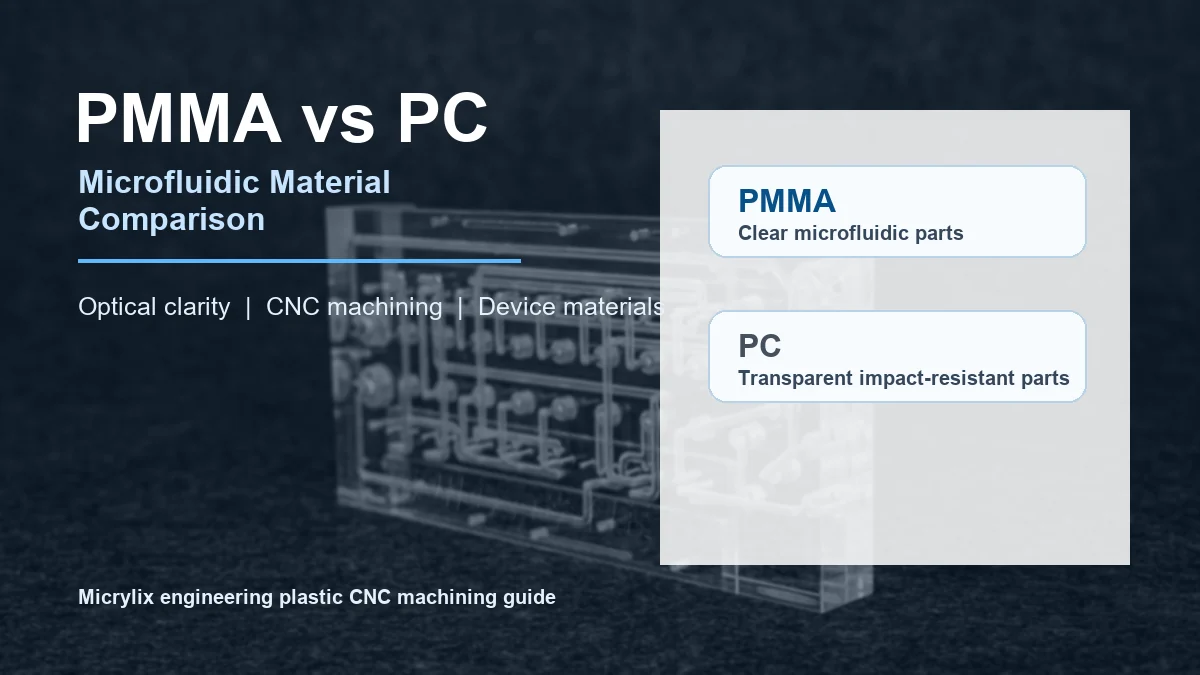
This guide compares acrylic, usually PMMA, with polycarbonate from a machining and design-for-manufacturing point of view. The focus is practical: impact behavior, optical finishing, heat, chemical stress cracking, clamping risk, and the details that often decide whether a prototype passes inspection or becomes scrap.
Acrylic and Polycarbonate Are Not Interchangeable Clear Plastics
PMMA is often selected when optical appearance, clarity, polishability, and low visual distortion matter. It is commonly used for transparent valve bodies, flow cells, inspection windows, display fixtures, and many visible fluid path components. It machines cleanly when tooling, feed, coolant, and clamping are controlled, but it is notch-sensitive and can crack if the design or process is careless.
Polycarbonate is normally selected when impact resistance and toughness are more important than the best possible optical finish. It can absorb far more impact energy than PMMA, and it is useful for guards, covers, housings, protective windows, and components that may be handled roughly. The tradeoff is that PC can be more difficult to finish optically, can smear during cutting if tools are dull, and can still suffer chemical stress cracking under the wrong cleaning or service environment.
1. Impact Behavior: Brittle Fracture vs Ductile Deformation
The most obvious difference between acrylic and polycarbonate is how they fail.
PMMA is relatively rigid and brittle. It does not tolerate sharp internal corners, poorly supported holes, thin tabs, or high local stress as well as PC. If the part is dropped, over-tightened, or loaded at a notch, acrylic may crack suddenly. That does not make PMMA a poor material; it simply means the part must be designed as a brittle transparent plastic, not as a clear metal substitute.
Polycarbonate is much tougher. Depending on grade and test method, its notched impact resistance can be many times higher than that of PMMA. Instead of shattering easily, PC tends to bend, dent, or yield before failure. This makes it a better choice for protective covers, access panels, machine guards, and parts that may see accidental knocks.
Engineering guidance: choose PC when impact or rough handling is a real service condition. Choose PMMA when the part is static, the loads are controlled, and optical finish is more important than impact abuse.
2. Optical Finish and Polishing: PMMA Is Usually Easier
If the machined part must look like a glass-like transparent component, PMMA usually has the advantage. Acrylic cuts with a cleaner chip when the cutter is sharp and the heat is controlled. Machined edges can often be improved by mechanical polishing, controlled vapor polishing, or carefully specified flame polishing.
That last point needs care. Flame polishing can make acrylic edges look clear, but it can also introduce surface stress. For precision components, sealing surfaces, bonded parts, or parts exposed to solvents, polishing method and stress relief should be discussed before production. A shiny edge is not automatically a stable engineering surface.
Polycarbonate is tougher but often less pleasant to finish. During machining it can smear, fuzz, or show haze if the tool is not sharp or if heat is allowed to build. Flame polishing is generally not suitable for PC because it can discolor, bubble, or damage the surface. Mechanical polishing or solvent-based finishing may be possible, but the process window is narrower and should be confirmed for the application.
For more detail on clear PMMA machining behavior, see our guide to transparent plastic machining and the article on why acrylic turns white after CNC machining.
3. Heat Resistance: PC Has More Margin, but Grade Still Matters
PMMA is not a high-temperature plastic. Many acrylic parts are comfortable in room-temperature and moderate-temperature environments, but long-term exposure near elevated temperatures can lead to creep, distortion, or loss of dimensional stability. Exact limits depend on grade, stress level, part geometry, and exposure time.
Polycarbonate generally offers a higher heat deflection and service-temperature range than PMMA. It is often preferred when the component is near warm equipment, lighting, heated air, or moderate thermal cycling. However, it should not be described as universally autoclave-safe or steam-resistant. Repeated steam, high stress, and aggressive cleaning can degrade some PC grades.
Engineering guidance: if continuous temperature, sterilization, or thermal cycling is part of the requirement, define the exact condition before choosing the material. Do not select either material from a single maximum-temperature number.
4. Chemical Stress Cracking: Cleaning Method Can Decide the Material
Chemical compatibility is where many transparent plastic parts fail after machining, not during machining.
PMMA is sensitive to alcohols, ketones, and many solvent-based cleaners, especially when residual machining stress is present. A clear acrylic manifold can look perfect after inspection and then develop fine cracks after being wiped with alcohol. The problem is not dirt on the surface; it is environmental stress crazing inside a stressed polymer surface.
Polycarbonate can also experience environmental stress cracking. It may tolerate some common cleaning conditions better than acrylic in certain applications, but it is not immune to alcohols, alkaline cleaners, oils, or prolonged chemical exposure. Compatibility must be checked against the actual grade, cleaner, temperature, concentration, and stress state.
Engineering guidance: if the part will be cleaned with IPA, exposed to reagents, or used in a fluid path, material selection should include chemical compatibility and stress-relief planning. For fluid control designs, see our plastic valve bodies and microfluidic components pages.
5. CNC Machining Behavior: PMMA Cuts Cleanly, PC Demands Heat Control
Both materials can be CNC machined successfully, but they ask for different process discipline.
- PMMA: benefits from very sharp polished cutters, clean chip evacuation, light clamping, and careful stress control. Poor tool choice or rubbing can create heat, whitening, micro-cracking, and edge chipping.
- PC: is tougher and less brittle, but it can smear or form fuzzy edges when the tool is dull. Heat control is still important because PC can soften and drag rather than forming a clean chip.
- Coolant: air blast, mist, or compatible water-based cooling may be used depending on the part and material. Avoid assuming that a standard metalworking coolant is safe for transparent plastics.
- Clamping: PMMA often needs softer support and more controlled clamping pressure. PC can tolerate more handling, but thin transparent features can still distort.
For drawing-based clear components, Micrylix reviews geometry, wall thickness, hole positions, finishing requirements, and cleaning conditions before machining. Our PMMA machining page explains this process in more detail.
6. Acrylic vs Polycarbonate CNC Machining Selection Guide
| Requirement | Usually Prefer PMMA / Acrylic | Usually Prefer Polycarbonate |
|---|---|---|
| Highest optical clarity and polished appearance | Yes | Possible, but finishing is harder |
| Impact resistance or protective function | Limited | Yes |
| Static transparent flow path or display part | Often suitable | Suitable if toughness or heat matters more |
| Thin tabs, rough handling, snap features | Higher cracking risk | Usually more forgiving |
| Flame polishing | Possible with process caution | Generally not recommended |
| Alcohol or solvent exposure | High crazing risk if stressed | Still requires compatibility review |
| Moderate elevated temperature | Limited margin | Usually better margin |
DFM Checklist Before Quoting Clear Plastic Parts
- Does the part need impact resistance, or is it mainly an optical component?
- Will the component be cleaned with IPA, alcohol, ammonia, or solvent-based cleaners?
- Are there sharp internal corners, thin walls, or holes close to an edge?
- Is edge clarity cosmetic, optical, or functional for inspection?
- Does the part need polishing, bonding, or post-machining annealing?
- What temperature and load will the part see in real service?
How Micrylix Supports Transparent Plastic CNC Machining
Micrylix manufactures drawing-based transparent plastic components including PMMA valve bodies, optical acrylic parts, visible flow blocks, inspection fixtures, and prototype fluid-control components. We do not treat “clear plastic” as one material category. Material selection, toolpath strategy, polishing method, and cleaning requirements are reviewed together.
If the part requires visible channels, polished surfaces, or fluid handling features, we can review whether PMMA, PC, or another engineering plastic is the better starting point. For broader material selection, visit our engineering plastic materials page.
FAQ
Can polycarbonate be flame polished after CNC machining?
In most engineering applications, no. Flame polishing is associated with acrylic, not polycarbonate. Applying flame to PC can discolor, bubble, or damage the surface. Mechanical polishing or controlled solvent-based methods may be considered depending on the part and grade.
Why did my machined acrylic part crack after cleaning with alcohol?
This is usually environmental stress crazing. CNC machining, clamping, drilling, and polishing can leave residual stress in PMMA. Alcohol can trigger fine cracks in those stressed areas, especially around holes, sharp corners, and machined surfaces.
Which material is better for microfluidic parts, PMMA or PC?
PMMA is often preferred when optical clarity, visible channels, and lower background fluorescence matter. PC may be selected when impact resistance or higher thermal margin is more important. Reagent compatibility, bonding method, and inspection requirements should be reviewed before final selection.
Conclusion
Acrylic and polycarbonate are both useful transparent plastics, but they solve different engineering problems. PMMA is usually the better choice for optical clarity, clean polishing, and static transparent components. PC is usually the better choice when impact resistance, toughness, or higher temperature margin is more important.
The safest selection comes from the application, not the datasheet alone. Send the drawing, material requirement, cleaning method, tolerance needs, and operating conditions before locking the material.