
Material Properties & Machining Notes
The points below are for reference only. Final material selection and tolerance planning depend on grade, stock condition, part geometry, and working environment.
Key Properties
CNC Machining Notes
- Use sharp tools and controlled feed to reduce stress marks.
- Avoid excessive heat buildup near clear channels and thin walls.
- Polishing and edge quality affect optical inspection and sealing surfaces.
- Tolerances depend on wall thickness, hole depth, and part geometry.
TRANSPARENT PMMA MACHINING
Transparent PMMA Machining Challenges
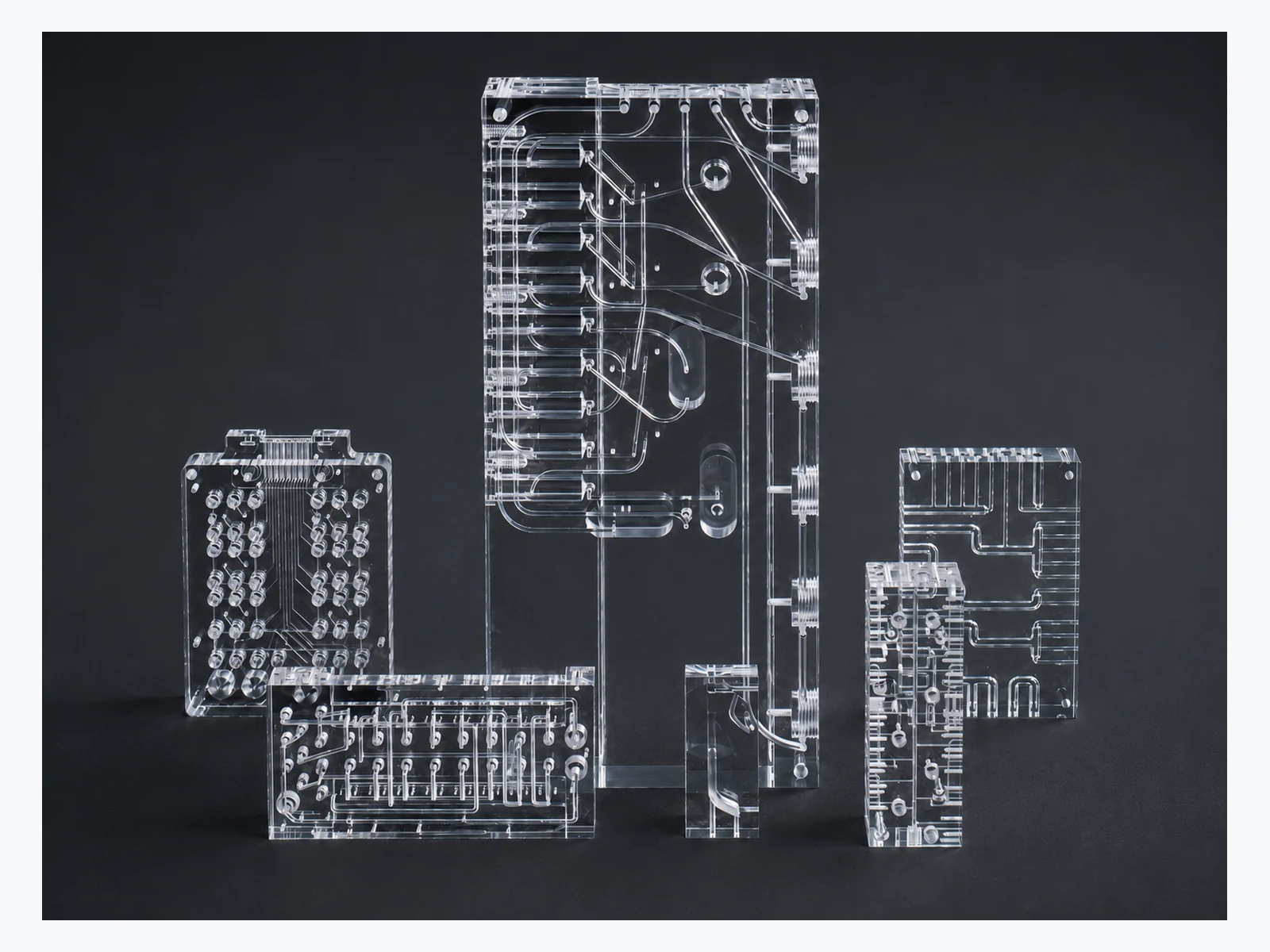
Transparent PMMA parts often reveal machining defects more clearly than opaque engineering plastics. Tool marks, internal stress, heat buildup, burrs around small holes, polishing marks and solvent sensitivity can all affect the final appearance of a clear acrylic component. For transparent valve bodies, microfluidic parts and optical inspection components, transparent plastic machining strategy, clamping method, cutter condition and finishing approach need to be reviewed before production. For more detail on stress marks, see our guide on why acrylic turns white after CNC machining.
Stress Whitening
Improper cutting conditions, sharp internal corners or excessive mechanical stress may cause visible whitening or crazing.
Burr Control
Small holes, ports and channels require careful burr control, especially for fluid-control and microfluidic components.
Surface Finish
Clear acrylic surfaces make tool marks and polishing quality easier to see than on opaque plastic parts.
Dimensional Stability
Part geometry, clamping and machining sequence can influence flatness, alignment and final dimensional stability.
Typical Applications
Common applications vary by material grade, tolerance, surface finish, and operating conditions.
Transparent Valve Bodies
Drawing-based CNC machined PMMA / Acrylic parts for technical equipment and precision assemblies.
Microfluidic Components
PMMA diagnostic components for transparent flow paths, optical inspection areas, and laboratory assemblies can be reviewed from customer drawings.
Optical Fixtures
Drawing-based CNC machined PMMA / Acrylic parts for technical equipment and precision assemblies.
Laboratory Inspection Parts
Drawing-based CNC machined PMMA / Acrylic parts for technical equipment and precision assemblies.
PMMA PART TYPES
Typical PMMA Parts We Machine
Transparent Valve Bodies
Machined PMMA valve bodies with visible fluid paths, ports, sealing faces and inspection areas.
Microfluidic Components
Clear PMMA plates, channels and test fixtures where fluid visibility and feature accuracy matter.
Acrylic Optical Parts
Transparent acrylic windows, inspection parts and optical fixtures machined from customer drawings.
Transparent Plastic Manifolds
PMMA manifold blocks and routing components for laboratory and fluid-control assemblies.
Flow Cell Components
Clear flow cells and viewing components where bore clarity, polishing and stress control need early review.
Laboratory Inspection Windows
Transparent PMMA windows and diagnostic instrument parts used for visual checks and fluid observation.
Clear Covers and Viewing Components
Custom acrylic covers and transparent machine components for inspection and equipment visibility.
Custom Drawing-Based PMMA Parts
Prototype and small-batch PMMA components machined according to drawings, samples or application notes.
Example Part
PMMA CNC Machined Component for Transparent Fluid Control
Requirement
A drawing-based transparent acrylic part may require clear channels, threaded ports, polished surfaces, and stable sealing areas. For a real production workflow, see our transparent acrylic valve body CNC machining case study, covering drawing review, CAM programming, CNC machining, inspection and final part review.
Machining Focus
- Clear flow paths and polished edges
- Thread and port machining without cracking
- Surface finish control for visual inspection
Result
The finished part supports visual inspection and controlled fluid handling after drawing review.
Need CNC machined PMMA / Acrylic parts?
Send your drawings, material requirements, quantity, tolerance requirements, surface finish expectations and application conditions. For transparent PMMA parts, please also mention whether visual clarity, fluid visibility, sealing surfaces or optical inspection areas are important.
Request RFQ