
When engineers compare PEEK and PTFE for semiconductor equipment, the question is often framed too simply: which material performs better?
That is not how polymer selection works in a wafer fab, wet bench, vacuum module, or automation system. A component may see thermal cycling, sustained clamping load, dry sliding contact, aggressive wet chemistry, vacuum exposure, ESD requirements, and tight dimensional control at the same time. A material that looks excellent on one datasheet row can become the wrong choice once the real operating conditions are considered.
PEEK and PTFE are both valuable semiconductor polymers, but they solve different engineering problems. PEEK is usually selected when stiffness, dimensional stability, load carrying, wear control, and precision machining matter. PTFE is usually selected when chemical resistance, low friction, and sealing behavior are more important than structural stiffness.
Neither material is universally superior. The right choice depends on grade, geometry, operating temperature, chemistry, load, cleanliness requirements, and how the part will be machined and inspected.
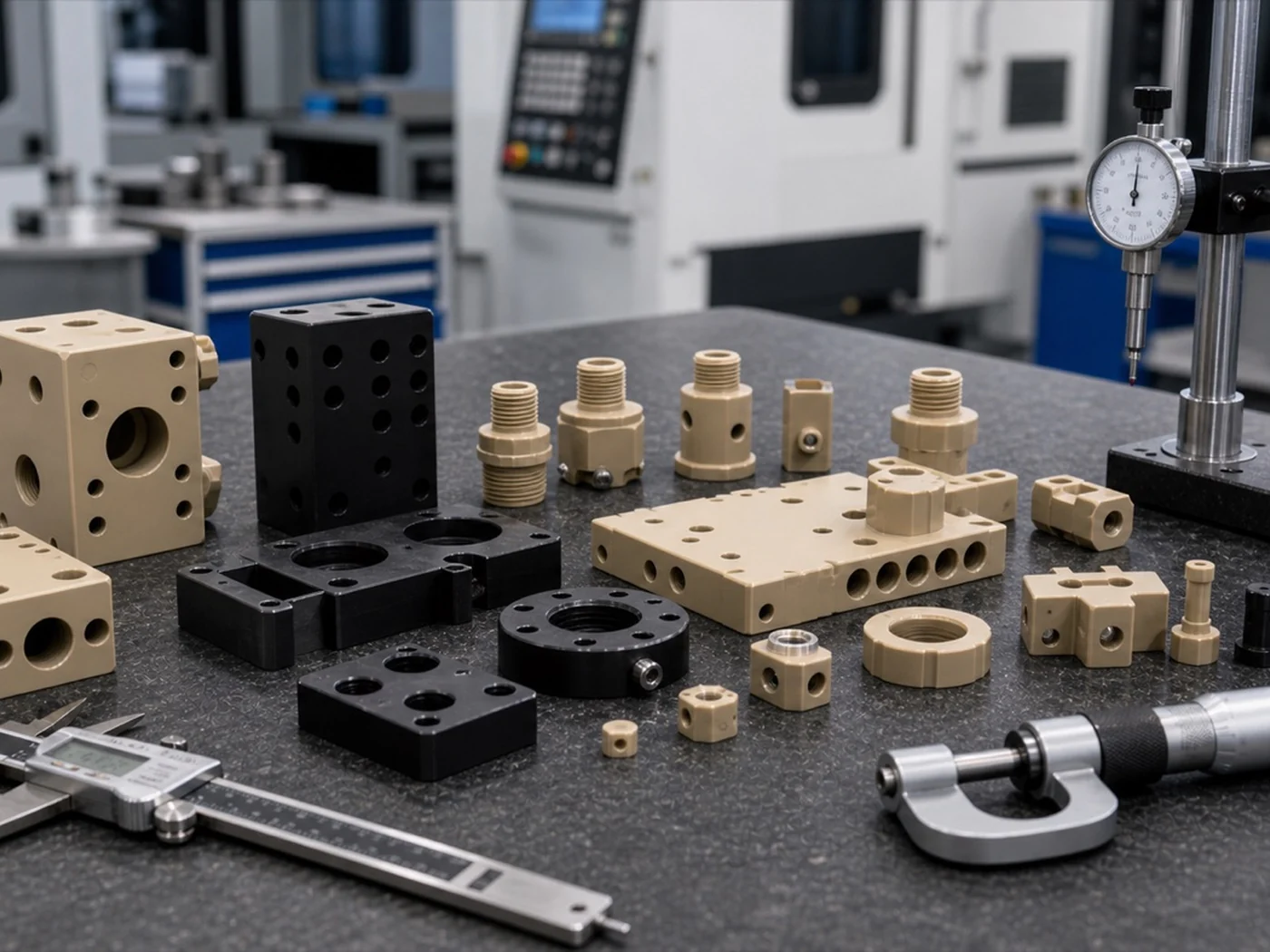
Quick Comparison: PEEK vs PTFE in Semiconductor Equipment
| Selection factor | PEEK | PTFE |
|---|---|---|
| Mechanical load | Better starting point for structural parts, fixtures, mounts, and components under sustained load. | Best kept for low-load sealing, lining, sliding, or isolation parts unless a filled grade is validated. |
| Creep behavior | Lower creep than PTFE under comparable load and temperature conditions. | Known for cold flow under sustained compression, especially in unfilled grades. |
| Dimensional stability | Generally more stable for tight-tolerance CNC machined components. | More difficult for tight geometry because the material is soft and can move during and after machining. |
| Chemical resistance | Good in many semiconductor-related environments, but compatibility must be checked for strong acids, halogens, and aggressive chemistries. | Often preferred for aggressive wet chemical contact, including many acids, bases, and solvents. |
| Friction and wear | Good wear behavior in selected grades; often considered where particle control and stiffness matter. | Very low friction, but transfer films, deformation, and wear debris must be evaluated in moving applications. |
| ESD control | ESD-safe grades are available, usually through conductive fillers. Filler effects must be reviewed. | Natural PTFE is highly insulating; static-dissipative grades require fillers that may affect purity and wear. |
| Vacuum and outgassing | Can be suitable when the correct grade, cleaning, and bake-out process are specified. | Can also be suitable, but stock quality and processing residues matter. Use documented high-grade material. |
| CNC machining | Machines more predictably than PTFE, but heat, stress, and tool wear still need control. | Machining is more difficult because of softness, elastic movement, burrs, and dimensional recovery. |
1. Mechanical Load, Creep and Dimensional Stability
The first question is whether the component carries load. If the part is a bracket, positioning block, sensor mount, robot fixture, spacer stack, or precision alignment component, PEEK is usually the safer starting point. It has higher stiffness and lower creep than unfilled PTFE, which helps preserve geometry under clamping force and temperature change.
PTFE behaves differently. It can deform slowly under sustained compression, a behavior often described as cold flow. This does not make PTFE unsuitable. It simply means pure PTFE should be used carefully in precision load-bearing parts. Filled PTFE grades can improve creep behavior, but fillers introduce another set of questions: wear behavior, contamination risk, and chemical compatibility.
Engineering takeaway: Use PEEK when load, stiffness, and repeatable positioning matter. Consider PTFE when the part is mainly a seal, liner, sleeve, or low-load sliding element.
2. Chemical Exposure and Wet Process Compatibility
PTFE is often selected for wet chemical exposure because it resists a very broad range of acids, bases, solvents, and process fluids. In wet benches, chemical handling assemblies, valve seats, seals, and liners, PTFE may be the more practical material when chemical survival is the dominant requirement.
PEEK also has strong chemical resistance for many engineering environments, but it is not a universal chemical barrier. Concentrated sulfuric acid, strong oxidizers, halogens, and certain high-temperature chemical conditions require careful review. If a PEEK component contacts process fluids, the actual concentration, temperature, exposure time, cleaning chemistry, and grade must be checked before release.
Engineering takeaway: PTFE is often preferred for aggressive wet chemistry. PEEK is often preferred when chemical exposure is moderate and the part also needs strength, stiffness, or precision-machined geometry.
3. Vacuum, Outgassing and Cleanliness
Both PEEK and PTFE can be used in vacuum-related semiconductor equipment, but neither should be approved by material family name alone. Outgassing behavior depends on grade, stock form, additives, machining contamination, cleaning, packaging, and bake-out history.
For vacuum-sensitive parts, ask for supplier documentation and define cleaning or bake-out requirements before machining. Avoid unknown recycled stock, low-grade commercial material, or undocumented filled grades in contamination-sensitive areas.
Engineering takeaway: Do not assume “PEEK” or “PTFE” automatically means low outgassing. Specify the grade and process requirements, then qualify the material against the actual tool environment.
4. Friction, Wear and Particle Risk
PTFE has a very low coefficient of friction, which is why engineers often reach for it in sliding or sealing applications. The tradeoff is that PTFE can generate transfer films and soft wear debris under motion. In a clean equipment area, that behavior should be tested, not assumed acceptable.
PEEK does not have the same natural low friction as PTFE, but it can be a better choice for loaded sliding components where stiffness, wear resistance, and dimensional control are important. Bearing-grade or filled PEEK may be considered, but filler content needs review for particle, ESD, and cleanliness requirements.
Engineering takeaway: Use PTFE when low friction is the main requirement and load is limited. Use PEEK when wear, stiffness, and particle-sensitive movement must be balanced.
5. ESD and Electrical Behavior
Unfilled PEEK and PTFE are both insulating materials. In wafer handling, automation, and inspection equipment, that can be useful or problematic depending on the design. If static control is required, engineers usually review static-dissipative or conductive grades.
PEEK has commercially available ESD grades that are often considered for precision handling components. PTFE can also be modified with fillers, but the filler package may affect chemical purity, wear behavior, and machinability. The correct choice depends on whether electrical behavior, cleanliness, or chemistry is the main design driver.
Engineering takeaway: Treat ESD as a grade-level decision, not a base-resin decision. Ask what filler is used and whether it is acceptable for the process environment.
6. CNC Machining and Tolerance Control
PEEK is generally more predictable to CNC machine than PTFE. It supports sharper features, better edge definition, and more stable inspection results when the machining strategy is controlled. That does not mean it is easy. Heat, internal stress, tool wear, and stock quality still matter, especially for thin walls and tight-tolerance parts.
PTFE is softer and more elastic. It can push away from the tool, leave burrs, deform under fixturing, and change dimension after unclamping. For simple seals, gaskets, sleeves, and liners, this is manageable. For deep precision pockets, small holes, threaded features, or tight mating geometry, PTFE can become costly and uncertain.
For PEEK-specific design guidance, see our CNC machining PEEK DFM guide.
Where PEEK Is Usually the Better Starting Point
- Wafer handling fixtures and positioning components
- Sensor mounts and insulating structural blocks
- Robot arm support parts and automation brackets
- High-temperature spacers and precision plastic supports
- Complex CNC machined parts with holes, pockets, threads, and locating features
- ESD-sensitive components when an appropriate PEEK grade is selected
For related examples, see our pages on semiconductor PEEK parts and PEEK CNC machining.
Where PTFE Is Usually the Better Starting Point
- Static seals, gaskets, and low-load isolation parts
- Chemical-resistant liners and sleeves
- Valve seats and low-friction contact surfaces
- Components exposed to aggressive wet chemistries where strength is secondary
- Parts where low friction matters more than stiffness or tight geometry
For machining context, see our PTFE machining and engineering plastic materials pages.
Practical Selection Checklist Before RFQ
- What is the maximum operating temperature and thermal cycling range?
- Does the part carry sustained load or only intermittent contact?
- Is the part exposed to wet chemistry, plasma, vacuum, or cleaning fluids?
- Are ESD or particle-control requirements defined?
- What tolerances are truly functional?
- Will the material be filled, unfilled, or semiconductor-oriented grade?
- Does the drawing include cleaning, packaging, and documentation requirements?
- Can the geometry be machined without excessive thin walls, deep pockets, or unstable fixturing?
How Micrylix Supports Semiconductor Polymer Machining
Micrylix manufactures drawing-based engineering plastic components for semiconductor equipment, laboratory instruments, microfluidic assemblies, and precision automation systems. For PEEK, PTFE, PAI / Torlon, PEI, PPS, POM, and PMMA parts, our review focuses on material grade, tolerance zones, machining access, burr control, surface finish, cleaning requirements, and inspection method.
If you are selecting between PEEK and PTFE for a semiconductor component, send the drawing and application notes. We can review whether the part is better approached as a structural precision component, a chemical-contact part, a sliding part, or a hybrid design requiring a different material strategy. You can also review related pages for semiconductor plastic parts and request a quote when your drawing is ready.